Like many ancient peoples, the Greeks valued honor above all things. It follows that the tragic ending to Oedipus should be riddled with last-ditch attempts at preserving one's honor. Sure enough, both the protagonist and his wife (mother!) close out the story with a dramatic display of decorum.
Jocasta, for her part, realizes the truth before her son and husband. "You're doomed--" yells Jocasta in her final moments, just before fleeing, "May you never fathom who you are!" (1173-1174). She runs from the scene, and these lines convey her desperation. She is before long found hanging in her bedchamber, unable to cope with the life she has made for herself.
Rather than continue on as wife and mother of the same man--a man she once tried to kill--Jocasta takes her own life, thereby salvaging the shreds of dignity she still possesses. This action shows that she, as a typical Greek, values honor and reputation more than her own life.
Similarly, no sooner does Oedipus find Jocasta's body than he takes the pins from her robes and stabs his own eyes out, crying, "'You, you'll see no more the pain I suffered, all the pain I caused!'" (1405-1406). As Oedipus has been "blind" to the truth through the play, it is fitting that he should disable his eyesight so gruesomely. A true Greek tragic hero, he gives himself a punishment worthy of his crime.
Both Oedipus and Jocasta attempt to right things in the end by delivering to themselves fates of which they think they are deserving. In doing so these two protagonists display characteristics of tragic heroes and personify true ancient Greek culture and beliefs regarding honor.
Monday, March 28, 2016

Blog Post 4
After seeing Jocasta committed suicide, Oedipus stabs his eyes out with the gold pins that held her robe together. By stabbing himself in the eyes, Oedipus blinds himself. He in essence becomes like the blind prophet, Tiresias, who earlier in the play he chastised. Tiresias says "I have escaped; the truth is what I cherish and that’s my strength."(404-405). Oedipus now has a newfound strength. Without his physical sight, he is able to see more on the "inside". he has more insight like a prophet and is able to look inside himself. Despite "[tearing] the brooches—the gold chased brooches fastening her robe— away from her and lifting them up high [dashing] them on his own eyeballs" (1455-1458), Oedipus does not make mention pain at all. The chorus asks "Is he now in any ease from pain?" (1475). The psychological pain he endures outweighs the physical pain so much that he does not fell physical pain at all. He is now no longer focused on the physical world, rather the psychological pain that goes along with realizing the truth. By realizing the prophecy about him is true, inadvertently Oedipus becomes more wise and in touch with himself. It is too late though.

Shameful Downfall of a True Leader
“To this guilt I bore witness against myself— with what eyes shall I look upon my people?” (1561-62). Decimated, humiliated, and confused, Oedipus cannot fathom the undeniable truth of being the murderer of his father, husband of his mother, and the product of adoption. The irony Sophocles reveals at the end of this story is mind-boggling and rather inconceivable. Throughout the entirety of the story, Oedipus refuses to believe the prophecy of Tiresias. When we finally discover he does the things Tiresias accuses him of, we are left in a state of awe and amazement. The allegations Oedipus attempts to circumvent haunt him like ghosts in a graveyard; he cannot avoid them. His reaction to this grief-stricken discovery is one of bitter remorse, for he decides to stab his eyeballs, causing eye damage and blindness. A leader who people envision as strong-minded and optimistic descends quickly to a weak and guilty suspect. “I beg of you in God’s name hide me somewhere outside your country, yes, or kill me, or throw me into the sea, to be forever out of your sight” (1586-89). Oedipus’s stigma delivers him a feeling of loneliness and embarrassment, for he asks for God to keep him out of his sight. He repeatedly requests for Creon to send him far away from Thebes, claiming that he does not deserve to remain in the city. His shame outweighs all the positive contributions and accomplishments he holds in Thebes, and forges a sympathetic view of life for himself and the city. The quote, “Give me liberty or give me death” by Patrick Henry accurately describes the situation. Oedipus does not feel he deserves to live after the allegations are proven to be true. With his failure to prosper, he believes death is the best option.

Dramatic Irony
The plot of Oedipus the King depends heavily on dramatic irony fueled by two valiant attempts to change the course of fate. Jocasta is told that her husband would die at the hands of her son; in an attempt to prevent this from happening she abandons her child leaving his fate up to the gods. Oedipus is told that he would kill his father and sleep with his mother. As to prevent this from happening, Oedipus takes matters into his own hands and flees Corinth. Instead of running from fate, he inadvertently runs towards it. He leaves Corinth only to find that in doing so he has found his real parents and carried out the oracle's words. Both Oedipus and Jocasta prematurely exult over the failure of oracles, only to find that the oracles were right after all. Each character’s attempt to escape fate creates dramatic irony because the audience knows that they are in no way escaping fate but rather expediting the process. Each time a character tries to avert the future predicted by the oracles, the audience knows their attempt is futile, creating the sense of irony that permeates the play. Both Oedipus and Jocasta think that taking action will keep fate from happening, but as they will soon learn fate is bound to happen.
Not only do Oedipus and Jocasta try to avoid the events that have been prophesied, they try to convince themselves and each other that prophecies are not true. Jocasta believes prophecies are false and convinces Oedipus the same, yet at the beginning of the very next scene we see her praying to the very same gods from which these prophecies originate. She "comes with prayers and offerings" giving the audience a sense that she may believe in prophecies after all (1008).
Irony of Jocasta
Throughout Oedipus the King, Oedipus refers to Jocasta for advice. The advice that he seeks resembles a relationship between a son and a mother. Oftentimes, a child succumbs to their parents in effort to receive advice or information. Jocasta shows the amount of wisdom that a mother possesses and shares this with Oedipus. Although Jocasta is his wife, Oedipus is ironically the son of Jocasta. This complex relationship ultimately evinces itself by the end of the story.
Jocasta reveals that she is wise and dependable as Oedipus oftentimes asks her for help in understanding or making a decision. In a time of discomfort and disbelief, Jocasta informs Oedipus that “even if [Teiresias] diverges from what he said then, he shall never prove that the murder of Laius squares rightly with the prophecy” (985-989). This shows Jocasta’s ability to serve as Oedipus’ mother and wife. Jocasta’s buoyancy of characterization presents Oedipus opportunities to seek advice and love her. Even though Oedipus is initially unaware of Jocasta being his mother, he gravitates to her for counsel. Jocasta ironically reveals her relationship with Oedipus as she says, “I am terrified when I look at you” (864-865). This may be because Oedipus is actually her son, even though they marry each other.
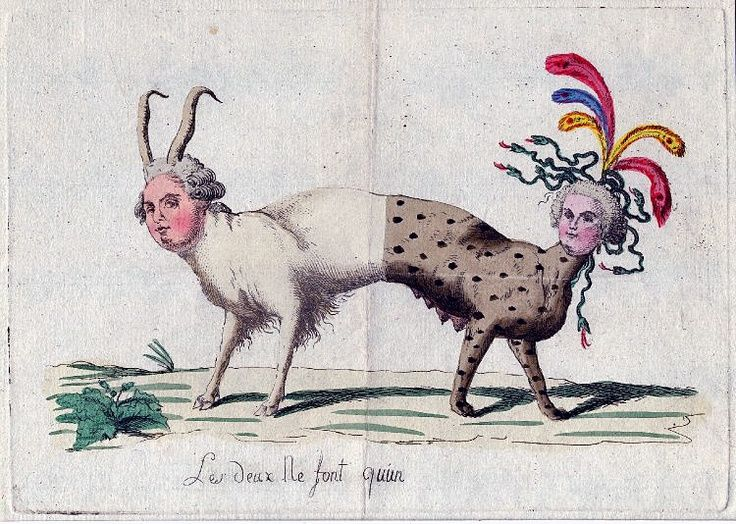 The political cartoon represents a two-headed being that has two different roles in society. It resembles the irony in Oedipus the King in that Jocasta is actually the wife and mother of Oedipus. This relationship manifests through the plot of the story. Jocasta is very influential on Oedipus as a mother and wife, but exemplifies her qualities of a mother in the character of his wife.
 Irony (Question #12)
An ironic moment in Oedipus, is at the climax of the play, when Oedipus finally
realizes that he is in fact the murderer of Laius and the one who fulfills
Tiresias’s prophecy. Oedipus realizes Tiresias speaks the truth when his wife,
Jocasta tells him about a prophecy which said her and Laius’s son would murder
Laius and sleep with her. Oedipus recognizes that this tale seems all too familiar
to his doings. His mind immediately starts racing with “what if” thoughts and
he starts asking Jocasta for more information, saying “Strange, hearing you just
now…my mind wandered, my thoughts racing back and forth.” (800-802) and “Where
dis this thing happen? Be precise.” (807). This moment is ironic because when
Tiresias had told Oedipus that he was the one responsible for the murder of
Laius, he was shocked that he could even suggest such an idea. Oedipus was
offended that Tiresias claimed this was the prophecy because he had vowed to be
the savior of Thebes, as he was their king. If this prophecy turned out to be
true, it would mean that he had betrayed the people of Thebes. Oedipus had
denied the claims made by Tiresias, saying he would never do such a thing but
then he realized that he was right. This plot twist was clearly unexpected for
Oedipus, realizing that Jocasta and Laius are his parents, as he stabs out his
own eyes with Jocasta’s brooches.

A Universal View of Pride
In the opening of the play, Oedipus
claims, “the world knows my fame: I am Oedipus” (9). He is ready and willing
to take on challenges and shout his successes. In the end, Oedipus comes to
realize the prophecy is fulfilled and exclaims: “It’s mine alone, my destiny—I am
Oedipus!” (1496). He begs Creon to kill or exile him. He uses the same phrase
in the beginning and end of the play to reflect his view of himself from the
beginning of the end of the play. We see Oedipus in the beginning, defining
himself by his triumphs and successes, full of pride. By the end, he realizes
that pride has contributed to his downfall and is finally humbled, defining
himself by the downfall and the destiny that he could not avoid. In this
manner, the play comes full circle, relaying the common message that hubris is
to be avoided.
Pride is recognized as detrimental not
only in Greek culture and religion, but in Christianity as well. Tragic Greek
heroes are not the only people who are in danger of excessive pride; pride can
be the downfall of anyone. Jesus relays this in a parable using a Pharisee and
a tax collector as examples. The Pharisee was prideful while the tax collector was
humble in prayer. The ultimate message is: “those who exalt themselves will be humbled
and those who humble themselves will be exalted” (New International Version, Luke 18.14). Warnings about pride can
also be found in the book of Proverbs, which reads: “Pride goes before
destruction, a haughty spirit before a fall” (Prov. 16.18), showing that pride
leads to destruction. This proves that the understanding that pride brings no good
to man is a universal topic that is applied not only to Greek heroes, but all
people.
 |
| This quote depicts pride as a cancer, which shows why it is a common theme in both Greek drama and Oedipus. Pride can so easily spread and blind a person, making it dangerous and a key contributor to Oedipus' fall. |
Subscribe to:
Posts (Atom)